
Showing posts with label tv. Show all posts

Wednesday, February 7, 2018

"Black Lighting" TV review


Black Lighting is a very good TV show from the CW network. It is well written, directed and acted, convincingly portraying the drama of a retired-crimefighter-turned-high-school-principal who turns back to his life of vigilantism when the growth of local organized crime threatens his daughters.

Now that I got the capsulized description out of the way, here is where I put a personal spin on this.

It was 1977 (I think). Reggie, Thurman, Sparky, and Billy were leading the Yankees to their first world series in decades. Elvis had just died. The Bronx was burning, but the battles of the Civil Rights movement appeared to be pretty much won, as far as I could tell. Just about everywhere you looked, whatever group or classification you looked at included a black person, even if it was one of the first back people in that group or classification. This included comic book superheroes. And comic books had just gone up in price to 30 cents.

A year or two earlier the Legion of Superheroes had been confronted by Tyroc, the first black superhero in the 30th century, but now here was one who fought crime in today's inner city! And he had his own comic book!

Written by Tony Isabella and drawn by 18-year-old Trevor Von Eeden, the story told of  Jefferson Pierce, a former Olympic athlete returning to his high school to begin his new job as a teacher, only to discover that the 100, a ruthless crime organization run by a giant albino named Tobias Whale (a thinly disguised rip-off of Marvel's Kingpin), had taken over the Metropolis inner-city ghetto known as Suicide Slum.

To battle this menace, his old friend, a tailor, made him a suit with a belt that gave him electrical powers. He wore a loose-fitting shirt that was open to the navel with a high collar and a mask built onto...wait for it...a fake afro!


(At least that was how I remembered it. A quick visit to the Wikipedia entry tells me that some things were a little different than I remember, but we this is the personal part of the review, after all.)

At the time, I was attending Manhattan Country School, a small private school aggressively engineered for diversity and founded under principles espoused by such great men as Dr. Martin Luther King, Jr., Mahatma Gandhi, and John Lennon. In this environment, I thought that anything "black" was cool, and since superheroes were cool, black superheroes were the coolest! I collected every issue of this exciting new comic, cut up the covers into Colorforms (like I did with all my comics), and then taped them all together into one large book (This being the first comic of which I was aware of getting the very first issue and I wanted to collect the whole story). I took red and blue pens and colored in the red and blue colors on some of the pages to make them brighter and even used a black ball-point pen to ink over the lines in some of the pages to make them darker. I read that collection over and over again, and practically knew it by heart.

I missed some of the issues after number five or six, and never really found out how the story ended. I do remember the old tailor having some sort of mystery, perhaps in organized crime, and he got killed or something, and the hero's powers (the ability to send an electrical charge through metal or project an electrical force-field around him that could deflect bullets from his belt) getting more and more augmented as the story went on, which was starting to concern the hero. I also remember that he was accused of killing someone, which he did not do, making him a fugitive from the law. This was about par for the course at the time, I thought, as Spider-Man, Batman, and Captain America were fugitives from the law for crimes they did not commit in comics I owned at the time.

Eventually his book was cancelled, and I next saw him in an issue of the "DC Dollar Comic" World's Finest in which he was actually working with Tobias Whale to bring down the 100. One thing I noticed about all successive artists of Black lightning after Trevor Von Eeden was that none of them got the shirt right. All the other artists made it fit his body skin-tight, with but some blousing of the sleeves. Black Lightning was supposed to have a loose-fitting shirt! Like a pirate! It was the 1970's! It was cool! Between that and the fake afro he had a sense of realism and being fashionably with the times.

As the hero, Jefferson Pierce put on a more "street" persona than he had in his civilian identity. He was tougher and spoke with more of the contemporary dialect and slang than did the stuffy schoolteacher (though to be fair, Jefferson Pierce did slam a drug dealer's face into a wall). In one story he used a bit of science to defeat a particular villain's powers, and even said "bet you didn't expect a STREET superhero to be SMART, did you?"

I enjoyed that comic. I liked the idea of black superheroes so much, I even created a team of them! There was Black Goliath, a professional boxer whose wife was an insect-inspired superhero (I forget the name). The Spark was a rip-off of Marvel's Electro, the Zinger was a speedster, and there was another character who had a suit like that hero in the Legion of Super Heroes whose who wears a helmet with a face-sized visor. I even drew the first page of a Black Goliath story, in which he was a boxer whose trainer was telling him he needed to hit harder. He then spotted a drug dealer in an alley and punched him in the stomach. I got as far as the trainer starting to tell him something, and yes, this was a rip-off of the first appearance of Jefferson Pierce at his the high school. And yes, I was inspired a bit by the movie Rocky, and yes, Marvel Comics already had their own Black Goliath, What do you want? I was ten!

So when I saw that there was going to be a Black Lighting show on TV, I had to watch it, and had to review it. So I wrote what you see above, saved it, then set it aside for a day as I went to work, went back to it, wrote a whole review about the show, bus somehow it failed to save, and when my laptop shut down for an update, everything I wrote was gone. So here we go again...

The show takes place some years after whatever the DC TV Universe equivilates to the story in the comics that I read. He is older, has two teenage daughters, has been married and divorced, and has been principal of a suburban, minority-neighborhood high school long enough to have an "understanding" with the local gangs, that his school was of limits. And he is bald and bearded.

His superhero identity has been "retired" and is even referred to as an "addiction." His powers appear to be within himself, rather than coming solely from his suit. When he does return to crimefighting, the old tailor gives him an updated costume; a bulky, armored affair with neon lightning bolts, goggles, and the now-ubiquitous superhero voice modulator. When he fights, he avoids killing people by his own hand, but he seems to have no compunction against using a bad guy as a human shield and letting other people's bullets kill him. And there is no fake afro.

I didn't mind the advancing age and family developments. I could see how having children might mellow him out from a ruthless vigilante to a realpolitik community man. But I missed the silk shirt, the lithe, athletic movements, and the fake afro.

I did appreciate the effort taken to give the characters "realistic" dialogue within the framework of TV standards and practices. Certain words and uses of grammar that are more often heard in the black community flowed naturally from the actors' mouths without a big deal being made of it. This sense of naturalism was welcome to this liberal-guilt-ridden child of the 1970's. It felt like the effort was taken to represent a realistic dialect without descending into stereotype.

There are also some dramatic elements I find interesting and worthy of bringing to TV, such as the choices faced by young people between fun and responsibility, the battle Jefferson Pierce faces, not against crime, but against his own urges to fight crime as a superhero, which is interpreted as an addition by his ex-wife, and how he tries to convince her (and himself?) that it is not.

I had a much more nuanced review of the show in my original version, but it has faded with time from my memory. Also, I have been cast in a play recently (ironically the play is being produced by a Black church in Brooklyn and is about the slave trade in early America) and rehearsals take away from my TV-watching time. But I could not get out of this review without sharing this picture:
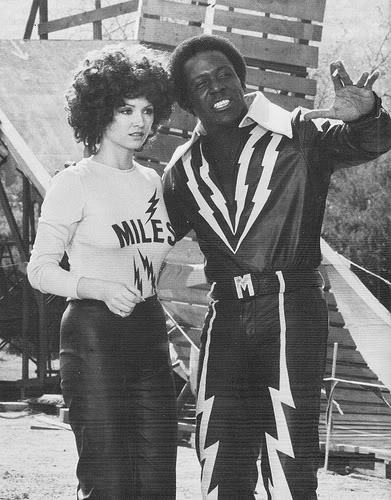

This is a picture of Richard Roundtree and Victoria Principal from the 1974 movie "Earthquake." I have a hard time not thinking that this outfit may have inspired the costume design for Black Lighting just a little bit ;) There is some discussion about it at Comic Book Resources. However, the proverbial horse's mouth says otherwise. Tony Isabella himself says so in his blog, which is quoted in this thorough article about the whole backstory behind Black Lightning and includes a bunch of developmental sketches of the hero.Apparently Trevor Von Eeden never saw the movie, and developmental sketches show a variety of designs that show more influence from Marvel's Power Man. Still, the similarity is amazing!

So, like many TV and movie adaptations of superhero comics, there are changes from the original, and some aspects of the original that I liked are completely different, but there is enough of the original intact that I do recognize the original in this new version. As a TV show, it creates enough interest beyond simply being the first black comic book superhero adaptation on TV (not he first black superhero show on TV, that would have been M.A.N.T.I.S, I think) that it is worth watching.

And finally, I give you this from Saturday night live, the best representaton of Black Lighning's costume ever on TV:


Tuesday, April 19, 2011

New channels, old shows and movies

A few weeks ago I was told of new channels on the new HDTV system that has been in effect for the past couple of years. I figured, then, that it must be time to re-scan for tv channels that could be picked up by my digital converter box.

The new channel selection reminds me of cable TV from the 1970’s. There are kids’ channels Spanish channels, shopping channels, Christian channels, Spanish kids’ channels, Spanish shopping channels, Spanish Christian channels, Spanish kids’ Christian shopping channels, Chinese Channels, Korean channels, and a few channels that show old TV shows and movies.

This is a great opportunity to see what the medium of television was giving us before cable TV and changing technology and social mores gave us the diversity, excitement, and mature subject matters we see today. Shows like “Robin Hood,” “Life with Elizabeth,” “I Married Joan,” “Ozzie and Harriet,” “Peter Gunn,” "Daniel Boone," and “Bat Masterson” show us the attempts that were made to fill time on TV with quality, wholesome entertainment. We also occasionally get to see some well-known actors in their younger days. Acting, writing, and directing styles were very different back then. We even get to see views of cultures that don’t exist anymore, like dinner/dance nightclubs and beat poets.

But what is more personally interesting (and addictive) is This TV (HDTV 11-3 in New York City), a station that shows nothing but movies almost all day and night (with some children’s shows in the morning). But most of the movies are the second-tier, lower-budget sequels and knock-off movies with less-well known actors. Instead of “Bad News Bears” we get “Here Come the Tigers.” Instead of “The Magnificent 7” we get “Guns of the Magnificent 7” and “Magnificent 7” Ride. Instead of “The Guns of Navarone” we get “The Iron Coast.” Instead of “The Wild Angels” we get “The Glory Stompers.” Instead of “Oceans 11,” James Bond, or even Matt Helm, we get “Salt and Pepper” and “One More Time.” Instead of "True Grit" we get "Rooster Cogburn." Instead of "Billy Jack" we get "The Born Losers."

I find it nice to see that these lesser-known works of pop culture get an opportunity to be screened, especially on free TV. Cable TV, the growth of the VCR (followed by the DVD and Blu-Ray), and the commercial effectiveness of the infomercial have meant that free TV has been showing fewer and fewer movies over the past two decades. And even on cable and at the video store, older and lesser-known movies have been drowned out by the ongoing crush of major blockbusters, reality TV, and the forward march of time.

I fear that This TV will go the way of many other stations that have been movie-heavy or had a single programming concept (WPIX in the 1980’s, MTV, The Nashville Network, the Sci-Fi Channel, WBIS). It will find greater profits in original programming and diversity. Then these movies will go back to the dustbins of film-making history. But for now, let’s enjoy seeing what our parents and grandparents saw, and let that inform us on where they came from when we don’t understand them.


Monday, February 7, 2011

Some Thoughts About Super Bowl XLV, 2011

To those pop stars who feel the Nation Anthem deserves a personal interpretation: Just sing the damn song.

Cowboys & Aliens had better not suck.

There should be more movies like the Kia Optima commercial.

Three fantasy commercials in a row: Coke/Dragon, Thor, VW Passat/Kid Vader

Coke makes a good commercial with a nice message. If only world peace and co-operation were as simple as sharing a coke. At least it’s a start. Life must have sucked for lonely 19th-century Latin-American border guards.

Very interesting approach taken by that Detroit car company making a luxury car. They made an extra-long commercial about Detroit that seems designed to get people to sympathize with the American auto industry and the people of that city. Well, it was effective, but made me wonder why they are not advertising an affordable, efficient, quality car that every American can own.

The halftime score, 21-10, is exactly the same as the final score of Super Bowl XII, Cowboys-Broncos, the first one I ever watched.

The Black Eyes Peas halftime show should go down as one of the best ever. It ranked up there with the year that Stevie Wonder played. Kudos to them for actually singing and not lip-synching. The Tron-inspired costumes and production design was appropriately spectacular and over the top. Having Slash enter to play “Sweet Child of Mine” was a nice touch and actually gave me chills. I do wish they had followed up with getting Dick Dale to play “Miserlou” in their song that samples it.

The montage of clips from TV shows about the Big Game was very clever.

The game itself was very exciting, a fast-paced, high scoring affair with lost of turnovers, and exciting offensive plays. Green Bay pulled out ahead early, but Pittsburgh, playing like the underdog they never have been in Super Bowls past, came back and kept the game interesting.

"XLV" stands for "Xtra Large Victory."

I missed the intro to the Pittsburgh Steelers before the game, but Sam Elliot’s into to the Green Bay Packers perfectly set the stage for the victory and return to glory that would ensue. Heck, I would listen to Sam Elliot read the phone book. Or Darwin.

Thursday, November 25, 2010

Some Thoughts About the Macy's Thanksgiving Day Parade 2010

The shong from Memphis is a fabulous Broadway musical number...just like every other fabulous Broadway musical number. It kind of made me think I was watching Family Guy, which has a lot of fabulous Broadway musical numbers.

The guy playing Jerry Lee Lewis in "Million Dollar Quartet" has totally got the moves of the Killer down. From what I saw here and on the Tony awards, though,makes me wonder if this is a musical play or a tribute concert.

Crystal Shawanda's Native American/County/Pop fusion fascinates me.

The U.S. has become a cultural colony of Japan. There were appearances by Hello Kitty, Takashi Murakami, Power Rangers Samurai, and Pikachu, and the NYPD Marching Band played the theme to Space Cruiser Yamato.

Those dancing penguins are cute!

HAAPY THANKSGIVING EVERYONE!

Friday, March 19, 2010

Hurrah for Universal Sports!

When the switchover to digital TV happened, and I finally got my digital converter box to work, it was small pile of "so what? Big deal." to me. So we got "crystal clear digital reception" now. That was only if the antenna was pointing in the right direction. Otherwise you got a perfectly black screen. Art least with analog we could sort of make out the picture through the snow and ghosties.

Sure, it's convenient to have a weather channel on 7-3,but Icould find out that kind of info by a quick look out the window most of the time.

Extra kids channels? That's merely an excuse to put less kids programming on the regular channels.

The Spanish stations seem to be doubled up. What's the point of that?

New York Nonstop and LiveWell, have yet to impress me with their programming (although LiveWell did show Martin Luther King, Jr.'s speches uncut late one night).

And what's with that channel that only shows certain roadways and intersections?

But NBC's Universal Sports ans just given me programming that has me saying "All Is Forgiven!" The Paralympics! Legless hockey! Armless biathlon! Visually-impaired cross-county skiing! Before this channel, I was lucky to stumble upon a few highlight on Wide World of Sports or something, but now I am getting the full games and events!

I can;t wait till the summer games to watch wheelchair rugby!

Friday, October 9, 2009

How My Sitcom Choices Reflect My Life

Hen I was a kid, I wanted to be popular in school, and I watched "Happy Days."

Over the past year I have spent some time dealing with relationship issues, and I watched "Two and a Half Men."

Now I am dealing with career issues, and I find myself watching "The Office."

Thursday, October 1, 2009

Comedy of the Awkward.

Tonight, in a fit of “Dammit, I just wanna,” I watched most of “Parks and Recreation” and all of “The Office” and “Community” on NBC (Channel 4 in NYC) tonight. These shows are part of a trend I like to call “Comedy of the Awkward.”

When my generation (specifically, me) was growing up, it was the era of “Free to Be You and Me.” Time was not spent on training us to behave and get along in society. We did not learn how to “fit in” and “get along.” We were allowed, nay, encouraged to “express ourselves.” There was no need to go into something with a preconceived notion, to blindly accept authority, to follow the rules. We could just “be ourselves,” say what we thought, and ask questions.

(…and just as a non-sequitor aside, don’t you hate it when something that your ex-girlfriend who is no longer talking to you got you interested in comes on TV and now the person you would have enjoyed talking about it with won’t talk to you? Yes, freestyle wrestling is on TV right now. Anyway…)

We were told never to assume that people are what they seem to be, not to judge a book by its cover. Trained that all people are just the same, only different, to be fair and honest and generous, to say what we mean and accept people at their word.

All this made us completely unable to get along with people who somehow missed the whole point of the 1960’s and ‘70’s, the people who went to school, got jobs, and went to work, who basically came before us and set up and ran the world that we would have to move into when we got out of the shelters of our progressive schools and enlightened families.

So there we were, uncomfortable in our new suits and constricting ties, awkwardly attempting to fit into the social scenes that we were not brought up in, squirming as we heard the jokes and assumptions that were made about different ethnicities, genders, financial status, sexual orientation, etc. Suffering the indignities foisted upon us by schemers and scammers, opportunists and assholes. We slowly, awkwardly, tragically came to realize that all that wonderful, utopian stuff we had been raised to believe has a snowball’s chance in hell at being accepted by the rest of the world just on the basis of its rightness.

And so, our life would be filled with awkwardness. Everything we would say and try to do would be misunderstood and wind up getting us in trouble. We would have to accept the fact that we are different and unique, and learn to either reject that and embrace the mainstream, or revel in it and fight that good fight, never compromising, even in the face of Armageddon.

And so Amy Poehler has to deal with people who don’t recognize her female political heroes and a judging committee for a beauty pageant that only sees the “hot” one. John Krasinski faces office rebellion when he finds himself having to decide how to distribute the raises for the year. Gillian Jacobs learns that helping someone live their dream does not always mean that you are going to get warm and fuzzies from them.

And this kind of comedy would not exist if it weren’t for my generation thinking that the world could ever be a different, better place.

Saturday, January 3, 2009

Is Everyone Gay?

I just channel-surfed into Channel 13's late-night indie film. In an early scene a woman making a toast at a wedding says that she wants to make love to the bride.

Well, this movie had no swords, soldiers, or spaceships, so I surfed away and landed on "Family Guy." It was an episode about gay marriage.

Is everyone gay?

Wait, I just surfed back to the movie on channel 13. She was not talking about the bride, she was talking about the groom and his two best friends.

Wow, did I read that wrong. Maybe it's just because it seemed so much like a sign pof the times that I assumed it was the other thing.

Well, I guess I can't rant on how I hope that everyone gets over this whole gay marriage thing. Legalize it and move on.

Friday, September 5, 2008

What the Hell's Kitchen Chef Taught Me

I usually don't watch "reality" shows or make time for "makeover" shows, but every once in a while I surf past one at get curious enough to stay tuned. Last night I stumbled on to "Kitchen Nightmares," Where Chef Gordon Ramsay goes into various restaurants that are not doing so well and fixes them up. In some cases all they need is a re-focusing of the menu and better efficiency in running the business. In others, the just need to be neutron-bombed and completely re-done from the ground up. In every case, after a visit to the restaurant as a customer and an observation of an evening, Gordon shuts down the place, makes changes, and when the place re-opens, it is a big success, and when he revisits, the place is doing even better because they have stuck with the changes.

Of course nothing is ever as perfect or quick as it appears on TV, but one thing does come through. In almost every case, the restaurants were poorly and inefficiently manged, certain egos were getting in the way of good work, and things needed to change. Gordon totally broke down the owners' and manager' egos and then showed them how to make the business work. Also, simplicity, focus, and efficiency were a big part of wheat he brought to the business.

This is a good lesson for a lot of us, especially people like me who are "all over the place." We have to cut out the crap, ditch the excess baggage which is holding us back, and focus on our strength. Ego is nothing. Success is everything.

Monday, August 18, 2008

Star Wars is Everywhere

I just saw the promo spot for this week's "Deal or No Deal," one of my least favorite game shows. It is Star Wars Week for them, apparently. All the girls will be dressed in "Slave Leia" costumes. I did make note of two things: 1. they were referred to as "Princess Leia," not "Slave Leia" (which make sense, after all, since "Princess..." is the name of the character as the general public knows her and "Slave..." is what we fans call her when she is in our favorite costume ;)), and that they were not wearing collars. And here I thought SM had entered the mainstream. I guess that would have just been a bit TOO daring for prime time.

Hipsters on the Hill

First, let me say that “King of the Hill” is the most respectable of the Sunday night cartoons. The characters in it all based in reality. Although they are caricatures, they are not impossible characters. As such, you can come to truly like and respect them, as opposed to simply being amused by them, as you would just about everyone in “The Simpsons,” “Family Guy,” and “American Dad.”

The lead character, Hank Hill, is the “anti-Simpson.” A reviewer pointed out that he, and the show, genuinely represented middle-class virtues. This is true. The man works hard in one of those jobs that you never think about but society as we know it could not live without. He sells and delivers propane. He believes in his product, and doing his job well. He accepts people for who and what they are, warts and all. He tries hard to see the good in people, no matter how little he understands them. And he genuinely appreciates things that he likes because he likes them, not because it is “cool” or “hip” to like them.

In tonight's episode, Hank's wife Peggy sells a house in a largely Mexican-populated neighborhood to a “hipster.” This hipster had wanted a house that was “real,” in other words, a neighborhood with no white, non-ethnic people, much like the neighborhoods I have moved into every time I have moved since I was 18: Harlem, Williamsburg, and Greenpoint. This, of course, was immediately followed by a wave of young people with questionable fashion sense playing kickball, skateboarding, and opening art galleries.

It seems that “real,” meaning “non-white” implies that there is a phoniness to white culture. That you can only be “real” is you are in a minority Perhaps this attitude is in the tradition of middle-class teenage rebellion against the apparently stifling limitations of middle class culture, against the emphasis on moderation and predictability that the suburbs became when WWII veterans came home, got married, and started raising kids. They felt that by moving into an “ethnic” neighborhood, the could get more “real.”

The truth is that, yes, suburban life is limiting. The culture that has built up there is largely a product of commercial marketing. But if you want to find a place to live that is not so much, just moving into one with no white people is not the answer.

The tradition of young people with artistic inclinations moving into ethnic neighborhoods can be traced to the American Bohemian movements of the 20th century. Artists have always lived on the edge of poverty, and thus have sought affordable housing, and showed a willingness to “rough it” in exchange for cheap living space. These spaces frequently turned out to be abandoned industrial and blighted ethnic ghettos. In the 1950's and early '60's, this took them to neighborhoods of New York City like Greenwich Village. In the '80's it was the East Village and TriBecCa. In the '90's it was Williamsburg, etc., etc. What would happen then is the process we now know as Gentrification.

Gentrification is the process by which a “real” neighborhood becomes a product of corporate capitalism. First come the artists, who hold events in the loft spaces of converted factories, etc. Then come the coffee shops and stores set up to serve the artists. Next come the wealthy people who want to see what the artists are doing. Then come the children of rich and middle class people who want to be artists. Then follow the entrepreneurs who open more fashionable coffee shops and boutiques to serve the reich people coming to see the artists and the children of the rich and middle class. By then the landlords have realized that they are sitting on a goldmine and start raising the rents, pushing out the original tenants and the first wave of artists, who now can no longer afford to live in the neighborhood they “revitalized.” By the time that's done, the only businesses who can afford to open there are large corporate chain stores like Starbucks and Victoria's Secret.

This process has become so efficient, streamlined, even, that it can bypass some of the steps, such as the artists moving in, and go straight to the children of the rich and middle-class wanting to live like artists, and that is what happened in this episode of “King of the Hill.” And looking at this particular story, that is what I find annoying about hipsters. In their worst manifestations, they are not really artists, they don;t really want to be artists, they just want to live like them.
There are three types of people. There are those who do things, like artists, cowboys, and recreational bowlers, for instance (doers). Then there are those who think it would be interesting or fun to do these things once or twice (tourists). They take art classes, go to dude ranches, make a date with friends to go bowling. Finally, there are those people who think it would be fun or cool to be the person who does these things. Those are hipsters. They are annoying because the ruin it for the rest of us, the doers and the tourists.

Doers can respect tourists if they have an interest in setting up an industry for them, That's why art classes and dude ranches exist. They take the tourists' money, give them what they paid for, and everyone goes home happy. Then the hipsters come in.

The hipsters walk into a place and say “Look at me! I'm being hip because I am doing this!” without truly digging what it is they are doing. The bad haircuts, aggressively out of shape bodies, and thrift-story little league t-shirts that don't fit are all symptoms of this. Real artists don't have time and money to get haircuts, work out, and buy clothes, that is why they look the way they do. By imitating this look, they are practically insulting the artists, as well as driving up the price of second-hand t-shirts. When they take over the ballfields to play kickball, they are not doing it because they really enjoy kickball over any other recreational sport, it is because of the irony of playing a kids game as a grown-up. They are not saying “I love this game,” they are saying “I love being being the person that plays this game.” When they do suburban middle-class things class things like set up lawn chairs and drink beer and have Tupperware parties, it is not because they are seeking the serenity that comes from a satisfying suburban middle-class lifestyle, ti is because it is fun to be ironic, and it is ironic that these “rebel artists” are doing suburban, middle-class things. And when they moved into the Mexican immigrants neighborhood, it was not because it was all they could afford, it was so that they could say “Look at me! I'm cool enough to hang with ethnic types and I'm bringing hip culture with me!”
Hank was in the neighborhood because one of his co-workers wanted him to say some words about his daughter on the occasion of her 15th birthday (a celebration in Mexican culture). There he discovered the best fish tacos he had ever tasted and other aspects of Mexican immigrant culture that he really liked. However, the hipsters had come in, acted like they were “bro's” of the locals, and playing their weird, depressing music in the local cantina. Then their presence raised the property values, and Hank's friend had his rent raised.

When Hank discovered that the fish taco he had enjoyed was now replaced with salmon, he realized that his wife's success as a realtor was spelling the end of a way of life of his friend. Peggy realized her mistake and together with their friends, they made the neighborhood appear as white and normal as any normal, white neighborhood. They showed up at the doorstep of a hipster couple with a casserole saying “welcome to the neighborhood!” They put on sweatsuits and went walking for exercise while pushing a baby carriage. They had their middle-aged white guy in an undershirt act like he had just bought the house next door. Soon the hipsters packed up their lawn chairs, art galleries, and kickballs and moved out.

That's the sort of outcome that could only happen on television.

Captain Zorikh
http://www.captainzorikh.com
http://www.bigapplecon.com

A New Highlander?

It seems that the Highlander is back, only this time he doesn't have a sword and he's a cop in New York. Or is it Forever Knight without the fangs?

The latest in a series of immortal adventurers is John Amsterdam, eponymous hero of New Amsterdam, a new series premiering tonight on Fox (Channel 5 in NYC). It seems this fellow saved the life of a Native American girl back in 1642 and was granted immortality as a reward. The further gimmick is that he has not left the colony he was living in at the time since then. That means he has seen the city now known as New York from its earliest days as a Dutch colony to today.

As a New Yorker and a history buff, I think this is a great opportunity to show the history of New York, which is fascinating, if not exactly glorious. I'm certain we will see flashbacks to Five Points since tho popularity of Gangs of New York, but I would love to see the 1950's of West Side Story, the late 1970's birth of Punk, the British occupation during the Revolution, and the corruption of Tammany Hall. It will also be interesting to see if they portray Robert Moses and the way he changed the face of the city.

Since this also reminds me of those other previous TV immortals, I am reminded how similar those two series, Highlander and Forever Knight, were Both had a centuries old immortal who fought agains injustce, had historical flashbacks, and a large car from the 1960's Both had a goofy sidekick and a female co-star in a profession not traditionally occupied by females. Both of these shows came out at the same time and as the years progressed, both wound up moving from one network to another, from one showing time to another, until eventually they died.

I wondered if the similarities were based on what the writers and producers thought the audience wanted, or if it is just a natural balance that such stories are supposed to have. Let's see what this show has, and hope that it does well.

Captain Zorikh
http://www.captainzorikh.com
http://www.bigapplecon.com

Monday, August 11, 2008

A Perfect "Wife Swap"

I normally don't watch TV shows like "Wife Swap." As most of you should know, or will know, as more of these media-related blogs come out, I usually watch things involving swords, spaceships, soldiers, or superheroes, but I was surfing through the channels after the News Hour on PBS and I saw a woman in a room filled with swords, dragons, and other fantasy things.

It turned out that this was an episode of "Wife Swap," (http://abc.go.com/primetime/wifeswap/index?pn=index) which actually did a recruitment drive at the Big Apple Convention last November. They toook a "perfect wife" from Kentucky and swapped her with a professional woman with a family of ghost hunters in Illinois. The Kentuckian lived in a family where she did all the work around the house while the husband went hunting and the daughters did whatever they wanted, and the stepdaughter did not get along with the dad. The Illinoisian went to work every day and her husband stayed at home and did everything around the house. For a week each wife had to live as the other wife had.

In both cases the women could not stand it. The Kentucky family expected the wife to do everything, cooking, cleaning, picking up dicarded cloithes, getting the kids ready for school, etc. The Illinois dad insisted on doing all the cooking and cleaning, even selecting the wife's clothes before she went to work in the office. The Illinois family was also vastly more educated than the Kentucky wife, and claimed to be psychic, and she felt very ignorant, even intimidated, in their presence.

By the end of the week both wives had had enough. When it was their turn to set the rules of the house, they insisted that things go the exact opposite. The Illinois husband would go to work, using his psychic abilities to help detectives solve crimes, and she would insist that they use no big words, like "inclusive." The Kentucky family would pick up after themselves, do their own laundry, and the husband would wash the dishes.

These rules met with mixed success. Then the second parts of the "changes" kicked in. The Illinois son, who had actually called the Kentucky wife "unintelligent," was sent on a blind date with a simple country girl. The Kentucky husband and his stepdaughter (who had much unreconciled hostility, had to role-play being each other to see what it was like.

The boy actually had a good time and thought the girl was an interesting person, but found out that he had hurt her feelings by being so insensitively smarter than her. The psychic dad found immediate success and fulfillment in work with a detective agency. The dad and stepdaughter realized how much they were hurting each other and how much they actually loved each other. The Kentucky family started helping the wife with the tasks they had always let her do.

In the end, the wives returned to their families and the two couples met and post-mortemed their experiences. In both cases, the couples were brought to tears. The Illinois dad realized how much he missed being appeciated and fulfilled the way work at the detective agency made him feel that way. The Illinois wife realized that her family needed her at home helping around the house and showing affection to her loved ones. The Kentucky dad realized how much hard work it is to do what he had always considered "women's work," and becaused he loved his wife, would be a better husband, and a better man, by helping, and not taking it for granted. The Kentucky wife realized that she should not let the family let her do all the work, and that it was actually better to stand up for therself, because she loved them.

My god, that was so frickin' perfect. Why can't all the relationship imbalances in our lives be resolved like this?