Here is last week's "Socially Distant Music Break," in which I do a bunch of songs I (mostly) wrote myself!
Post in the comments which songs you like best!
Wednesday, April 8, 2020


Wednesday, April 1, 2020
Captain Zorikh Social Distance Music Break #1 Death Star Repairman
So I have decided to join with the ranks of folks like John LEgend and Willie Nelson and play live music over the internet to help make a few minutes of folks' Covid-19 quarantine more tolerable.
Here is the first of them, done as the "Death Star Repairman." Enjoy!
Here is the first of them, done as the "Death Star Repairman." Enjoy!
Thursday, March 5, 2020
182 Graham: Yet Another Unauthorized Entry
Here is the third of the four unauthorized entries building management has committed into my room without my notification, knowledge, or permission.
We are still waiting for that "plan" from building management to make the place legal to let us move back in.
The next court date is March 19, 2020.
Friday, February 21, 2020
1917 movie review

1917 is an excellent movie, well deserving recognition for its cinematography and direction. It is a "must see" war movie, especially among WWI movies, and, as so many WWI movies do, expresses the pointlessness of so much of that war.
It was not the movie I expected, though. I had read a review that said that it was like a feature length version of the last scene of Gallipoli, the movie about Australians in the failed Turkish captain of that war, starring Mel Gibson. That final scene of the Australian Light Horse going "over the top" in a futile charge to allow the British to land tore my heart out when I first saw it when I was 12 years old, and had the same effect when I saw it again when I was around 20. Such a comparison reminded me of one made of Mel Gibson's The Passion of the Christ, saying that it was basically the last scene of Braveheart extended over the length of a full movie.
Though the story dynamic was essentially the same (runners told to deliver a message to stop a potentially disastrous attack) There was none of the on-screen death and bloodshed that we saw in the earlier movie. There is very little actual "battle action" in the movie. Most of the movie is about the territory covered by the two British soldiers as they traverse the land to deliver the message.
And what diverse ground it is! They go from crowded trenches to blasted no-man's-land to subterranean tunnels to open farmland, walking, crawling, riding in trucks, crossing rivers, and running through the ruins of a mostly-demolished town. They are constantly surrounded by death. Dead soldiers, dead animals, dead land, in all states of decomposition. Every conversation in every encounter involves death, which I gather from, well, everything about the First World War, is what that war (and every war, really) was about. No war as famously had so many soldiers living in such close proximity of death nonstop for such a long time, which is why it is the defining characteristic of that "war to end all wars," which didn't. This movie definitely gets that across.
Even the title of the movie, and the opening words on the screen (a date in April, 1917) help to strike home the awfulness of the fact of the war, as it was destined to go on for another year and a half after the events in this movie.
One cannot say enough about the production design of this movie. The constant appearance of dead bodies in all their infinite varieties, as common in the landscape as bushes or trees might be in a lightly wooded countryside, is both impressive and oppressive in its omnipresence. The rats crawl around and literally through them. The med react, or don;t react, to them in ways that completely fit with the respective context. And of course the omnipresence of dead bodies provides many opportunities for contest.
But even with all this death, there are beautiful landscapes through the movie. They provide a welcome contrast, and the transitions from one to another are remarkable.
The film is edited to look like it was shot in one long single take, much in the manner of Birdman. Of course it was not, and, in fact, I kind of forgot that it looked like it was all one take. I suppose my mind, used to cuts and transition, simply assumed that there were cuts and transitions.
The friendship between the two soldiers is real and engaging, although one of them looks too much like the actor who plays that evil bounty hunter in The Man in the High Castle for me to feel too much sympathy at the beginning.
There are certain cliches that are in almost every war movie, and 1917 has a bunch of them. It is a sign of how well the movie is made that they are unexpected, never feel like cliches, and the emotional beats hit home. This was in welcome contrast to such films as the cliche-ridden Patriot (Hah! Another Mel Gibson reference!) and Platoon that had me truly laughing out loud.
The "star cameos" (Mark Strong, Benedict Cumberbatch) were noticeable, and, though unnecessary, not nearly as distracting as Ted Danson in Saving Private Ryan.
There was another movie about World War I that I saw on Vudu recently that shared some thematic similarities but had significant differences. I may review that also if I get the chance.
Here is some background on the characters and events of the film:
https://time.com/5751665/1917-movie-history/
And here are some more videos about the movie:
Wednesday, February 7, 2018
"Black Lighting" TV review

Black Lighting is a very good TV show from the CW network. It is well written, directed and acted, convincingly portraying the drama of a retired-crimefighter-turned-high-school-principal who turns back to his life of vigilantism when the growth of local organized crime threatens his daughters.
Now that I got the capsulized description out of the way, here is where I put a personal spin on this.
It was 1977 (I think). Reggie, Thurman, Sparky, and Billy were leading the Yankees to their first world series in decades. Elvis had just died. The Bronx was burning, but the battles of the Civil Rights movement appeared to be pretty much won, as far as I could tell. Just about everywhere you looked, whatever group or classification you looked at included a black person, even if it was one of the first back people in that group or classification. This included comic book superheroes. And comic books had just gone up in price to 30 cents.
A year or two earlier the Legion of Superheroes had been confronted by Tyroc, the first black superhero in the 30th century, but now here was one who fought crime in today's inner city! And he had his own comic book!
Written by Tony Isabella and drawn by 18-year-old Trevor Von Eeden, the story told of Jefferson Pierce, a former Olympic athlete returning to his high school to begin his new job as a teacher, only to discover that the 100, a ruthless crime organization run by a giant albino named Tobias Whale (a thinly disguised rip-off of Marvel's Kingpin), had taken over the Metropolis inner-city ghetto known as Suicide Slum.

(At least that was how I remembered it. A quick visit to the Wikipedia entry tells me that some things were a little different than I remember, but we this is the personal part of the review, after all.)
At the time, I was attending Manhattan Country School, a small private school aggressively engineered for diversity and founded under principles espoused by such great men as Dr. Martin Luther King, Jr., Mahatma Gandhi, and John Lennon. In this environment, I thought that anything "black" was cool, and since superheroes were cool, black superheroes were the coolest! I collected every issue of this exciting new comic, cut up the covers into Colorforms (like I did with all my comics), and then taped them all together into one large book (This being the first comic of which I was aware of getting the very first issue and I wanted to collect the whole story). I took red and blue pens and colored in the red and blue colors on some of the pages to make them brighter and even used a black ball-point pen to ink over the lines in some of the pages to make them darker. I read that collection over and over again, and practically knew it by heart.
I missed some of the issues after number five or six, and never really found out how the story ended. I do remember the old tailor having some sort of mystery, perhaps in organized crime, and he got killed or something, and the hero's powers (the ability to send an electrical charge through metal or project an electrical force-field around him that could deflect bullets from his belt) getting more and more augmented as the story went on, which was starting to concern the hero. I also remember that he was accused of killing someone, which he did not do, making him a fugitive from the law. This was about par for the course at the time, I thought, as Spider-Man, Batman, and Captain America were fugitives from the law for crimes they did not commit in comics I owned at the time.
Eventually his book was cancelled, and I next saw him in an issue of the "DC Dollar Comic" World's Finest in which he was actually working with Tobias Whale to bring down the 100. One thing I noticed about all successive artists of Black lightning after Trevor Von Eeden was that none of them got the shirt right. All the other artists made it fit his body skin-tight, with but some blousing of the sleeves. Black Lightning was supposed to have a loose-fitting shirt! Like a pirate! It was the 1970's! It was cool! Between that and the fake afro he had a sense of realism and being fashionably with the times.
As the hero, Jefferson Pierce put on a more "street" persona than he had in his civilian identity. He was tougher and spoke with more of the contemporary dialect and slang than did the stuffy schoolteacher (though to be fair, Jefferson Pierce did slam a drug dealer's face into a wall). In one story he used a bit of science to defeat a particular villain's powers, and even said "bet you didn't expect a STREET superhero to be SMART, did you?"
I enjoyed that comic. I liked the idea of black superheroes so much, I even created a team of them! There was Black Goliath, a professional boxer whose wife was an insect-inspired superhero (I forget the name). The Spark was a rip-off of Marvel's Electro, the Zinger was a speedster, and there was another character who had a suit like that hero in the Legion of Super Heroes whose who wears a helmet with a face-sized visor. I even drew the first page of a Black Goliath story, in which he was a boxer whose trainer was telling him he needed to hit harder. He then spotted a drug dealer in an alley and punched him in the stomach. I got as far as the trainer starting to tell him something, and yes, this was a rip-off of the first appearance of Jefferson Pierce at his the high school. And yes, I was inspired a bit by the movie Rocky, and yes, Marvel Comics already had their own Black Goliath, What do you want? I was ten!
So when I saw that there was going to be a Black Lighting show on TV, I had to watch it, and had to review it. So I wrote what you see above, saved it, then set it aside for a day as I went to work, went back to it, wrote a whole review about the show, bus somehow it failed to save, and when my laptop shut down for an update, everything I wrote was gone. So here we go again...
The show takes place some years after whatever the DC TV Universe equivilates to the story in the comics that I read. He is older, has two teenage daughters, has been married and divorced, and has been principal of a suburban, minority-neighborhood high school long enough to have an "understanding" with the local gangs, that his school was of limits. And he is bald and bearded.
His superhero identity has been "retired" and is even referred to as an "addiction." His powers appear to be within himself, rather than coming solely from his suit. When he does return to crimefighting, the old tailor gives him an updated costume; a bulky, armored affair with neon lightning bolts, goggles, and the now-ubiquitous superhero voice modulator. When he fights, he avoids killing people by his own hand, but he seems to have no compunction against using a bad guy as a human shield and letting other people's bullets kill him. And there is no fake afro.
I didn't mind the advancing age and family developments. I could see how having children might mellow him out from a ruthless vigilante to a realpolitik community man. But I missed the silk shirt, the lithe, athletic movements, and the fake afro.
I did appreciate the effort taken to give the characters "realistic" dialogue within the framework of TV standards and practices. Certain words and uses of grammar that are more often heard in the black community flowed naturally from the actors' mouths without a big deal being made of it. This sense of naturalism was welcome to this liberal-guilt-ridden child of the 1970's. It felt like the effort was taken to represent a realistic dialect without descending into stereotype.
There are also some dramatic elements I find interesting and worthy of bringing to TV, such as the choices faced by young people between fun and responsibility, the battle Jefferson Pierce faces, not against crime, but against his own urges to fight crime as a superhero, which is interpreted as an addition by his ex-wife, and how he tries to convince her (and himself?) that it is not.
I had a much more nuanced review of the show in my original version, but it has faded with time from my memory. Also, I have been cast in a play recently (ironically the play is being produced by a Black church in Brooklyn and is about the slave trade in early America) and rehearsals take away from my TV-watching time. But I could not get out of this review without sharing this picture:
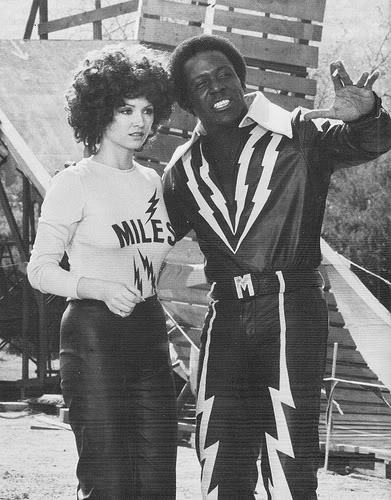
This is a picture of Richard Roundtree and Victoria Principal from the 1974 movie "Earthquake." I have a hard time not thinking that this outfit may have inspired the costume design for Black Lighting just a little bit ;) There is some discussion about it at Comic Book Resources. However, the proverbial horse's mouth says otherwise. Tony Isabella himself says so in his blog, which is quoted in this thorough article about the whole backstory behind Black Lightning and includes a bunch of developmental sketches of the hero.Apparently Trevor Von Eeden never saw the movie, and developmental sketches show a variety of designs that show more influence from Marvel's Power Man. Still, the similarity is amazing!
So, like many TV and movie adaptations of superhero comics, there are changes from the original, and some aspects of the original that I liked are completely different, but there is enough of the original intact that I do recognize the original in this new version. As a TV show, it creates enough interest beyond simply being the first black comic book superhero adaptation on TV (not he first black superhero show on TV, that would have been M.A.N.T.I.S, I think) that it is worth watching.
And finally, I give you this from Saturday night live, the best representaton of Black Lighning's costume ever on TV:
Tuesday, January 2, 2018
Star Wars: The Last Jedi: Review
This is the best Star Wars movie so far. "The Empire Strikes Back," of which it shares the most common elements, is close behind, but still lacking strength in a few very important elements that give this one the edge.
Sunday, December 24, 2017
New tech, old feeling, remarkable effect in TFTNC's "A Christmas Carol"
Hi everybody. I know it has been a while since I have posted anything here, much less a theater review, but I really wanted to share what I experienced at last night's performance of David Zen Mansley's adaptation of Charles Dickens' "A Christmas Carol" at Theatre for the New City.
I have been going to the Halloween party at Theatre for the New City for many years, and it has always given me a sort of post-apocalyptic feeling. The walls are black, the seats are low-cost, the tech is rudimentary, and everyone is dressed as if they are wearing whatever they could find and put together creatively. The performances are gloriously inspired and talented, but with that low-budget, can-do eccentricity and anti-professional sheen that says "this is not a glossy Broadway production that Aunt Edna and her husband bought tickets to because it was based on that favorite movie and stars that movie star who was in that movie she liked."
My theory of the post-apocalypse aesthetic is that the survivors will be wearing, decorating, and entertaining with whatever they can find, despite heir imperfections and appropriateness. However, this does put the subject of the presentation into a new, unfamiliar context that perhaps can bring out some tort of deeper meaning or new revelation from the source material. Last night's performance was no exception to that, and it worked marvelously!
There is a balance in any production between the text, the set, the props, the cast, and showmanship. (and musical numbers, if applicable). I have seen this story played out with Alistair Sim, Albert Finney, Henry Winkler, Patrick Stewart, Michael Caine with the Muppets, Mr. Magoo, and an an animated TV special (some of these several times), but never was that balance so finely attuned that every element of the story came through as clearly as it did in this version.
The set was minimal, but with a strong unified aesthetic. The one room served (depending on where on the stage the action played and which characters were present) as Scrooge's office, his bedroom,. the home of Bob Cratchit, and Joe's Beetling shop. There was a bed at stage right, a fireplace at stage left, a table downstage left, and a door in a corner upstage right. The back wall was a light tan color, fading into dark sepia at the edges.
It was against this back wall that Scrooge's visions appeared. They were projected video, but with the sepia tone, the old-timey look of the set and the low-tech production, I could not help but feel that I was watching an old silent film being projected. It felt not like the film was old, but that it was 1914 and I was watching a creative new use of the new medium of film to add a supernatural element to the production with this new special effect! The fact that the spirits and visions spoke did not take me out of that, I could have (if I cared) justified it by assuming it was an actor behind the screen or a Victrola being played simultaneously (I believe Thomas Edison invented a device that could do that).
All of the dreams and visions that Scrooge experienced were either shown on this screen or described in dialogue between Scrooge and the Spirits. It was through this that for the first time I learned about Scrooge's lonely childhood and how he was affected by the loss of his sister.
Another element of the production that played surprisingly well into the message of the story was the Cratchits' Christmas dinner. I don't know if it was due to budget, practicality, or a deliberate choice, but though the table was set with a full compliment of dishes, silverware, and drinking vessels, not a scrap of food could be seen. Bob Cratchit pantomimed serving the goose and the pudding, then taking the first bite of each. After each of those bites he praised the excellence and perfection of each dish to his wife, who blushed with effusive modesty. Whether or not it was a deliberate choice to have the plates bare and the cups empty, whether it was meant to be symbolic or deliberate, seeing the love and joy that the family could share without a scrap of food brought home the meaning of the season better than a hundred "Grinch that Stole Christmas" Broadway musicals.
It was also through the minimalism of the set, masterful editing of Dickens' text, and the spirited performance of the actors that never before did the good will of Scrooge's nephew and the mean-spirited opportunism of the vultures in the beetling shop come across so clearly and their import in the story be felt so well.
Mansley has produced this play annually for several years, and plans to continue doing so. I heartily encourage a visit to this play as part of a unique New York City experience of the season, and also to get a fresh perspective on the story and its meaning.
The original text:
Versions I have seen:
Versions I have not seen:
Inspired by the original...
I have been going to the Halloween party at Theatre for the New City for many years, and it has always given me a sort of post-apocalyptic feeling. The walls are black, the seats are low-cost, the tech is rudimentary, and everyone is dressed as if they are wearing whatever they could find and put together creatively. The performances are gloriously inspired and talented, but with that low-budget, can-do eccentricity and anti-professional sheen that says "this is not a glossy Broadway production that Aunt Edna and her husband bought tickets to because it was based on that favorite movie and stars that movie star who was in that movie she liked."
My theory of the post-apocalypse aesthetic is that the survivors will be wearing, decorating, and entertaining with whatever they can find, despite heir imperfections and appropriateness. However, this does put the subject of the presentation into a new, unfamiliar context that perhaps can bring out some tort of deeper meaning or new revelation from the source material. Last night's performance was no exception to that, and it worked marvelously!
There is a balance in any production between the text, the set, the props, the cast, and showmanship. (and musical numbers, if applicable). I have seen this story played out with Alistair Sim, Albert Finney, Henry Winkler, Patrick Stewart, Michael Caine with the Muppets, Mr. Magoo, and an an animated TV special (some of these several times), but never was that balance so finely attuned that every element of the story came through as clearly as it did in this version.
The set was minimal, but with a strong unified aesthetic. The one room served (depending on where on the stage the action played and which characters were present) as Scrooge's office, his bedroom,. the home of Bob Cratchit, and Joe's Beetling shop. There was a bed at stage right, a fireplace at stage left, a table downstage left, and a door in a corner upstage right. The back wall was a light tan color, fading into dark sepia at the edges.
It was against this back wall that Scrooge's visions appeared. They were projected video, but with the sepia tone, the old-timey look of the set and the low-tech production, I could not help but feel that I was watching an old silent film being projected. It felt not like the film was old, but that it was 1914 and I was watching a creative new use of the new medium of film to add a supernatural element to the production with this new special effect! The fact that the spirits and visions spoke did not take me out of that, I could have (if I cared) justified it by assuming it was an actor behind the screen or a Victrola being played simultaneously (I believe Thomas Edison invented a device that could do that).
All of the dreams and visions that Scrooge experienced were either shown on this screen or described in dialogue between Scrooge and the Spirits. It was through this that for the first time I learned about Scrooge's lonely childhood and how he was affected by the loss of his sister.
Another element of the production that played surprisingly well into the message of the story was the Cratchits' Christmas dinner. I don't know if it was due to budget, practicality, or a deliberate choice, but though the table was set with a full compliment of dishes, silverware, and drinking vessels, not a scrap of food could be seen. Bob Cratchit pantomimed serving the goose and the pudding, then taking the first bite of each. After each of those bites he praised the excellence and perfection of each dish to his wife, who blushed with effusive modesty. Whether or not it was a deliberate choice to have the plates bare and the cups empty, whether it was meant to be symbolic or deliberate, seeing the love and joy that the family could share without a scrap of food brought home the meaning of the season better than a hundred "Grinch that Stole Christmas" Broadway musicals.
It was also through the minimalism of the set, masterful editing of Dickens' text, and the spirited performance of the actors that never before did the good will of Scrooge's nephew and the mean-spirited opportunism of the vultures in the beetling shop come across so clearly and their import in the story be felt so well.
Mansley has produced this play annually for several years, and plans to continue doing so. I heartily encourage a visit to this play as part of a unique New York City experience of the season, and also to get a fresh perspective on the story and its meaning.
The original text:
Versions I have seen:
Versions I have not seen:
Inspired by the original...
Subscribe to:
Posts (Atom)


 Posts
Posts

